Tuesday, October 4, 2022

LUIS EDUARDO AUTE: SPANISH ARTIST, MANILEÑO || Gem Suguitan


 “Tagalog? I feel like it is family, no? When I see a Filipino, I feel like they are family. When I meet a Filipino, I am a Filipino at heart as well.” These were the words of Luis Eduardo Aute in the video concert “Con tu latido: Filipinas canta a Luis Eduardo Aute. A tribute,” during his 79th birth anniversary held on September 13th at Instituto Cervantes in Intramuros, Manila.

Born in the midst of Japanese Occupation in 1943, Aute studied at De La Salle School. He spoke English and Tagalog before settling down in Spain in 1954. If he didn’t leave the country, he must have been one of the most famous artists from Manila. But he made it in Madrid! And it’s about time that Filipinos get to know this artist even just through his works. His avant-garde style and ability to write in original way earned him a special place among Spanish singer-songwriters. As an artist born in the Philippines, it is but right that his legacy be shared with the Filipinos as well: the reason for this collaboration by Instituto Cervantes, the Embassy of Spain in the Philippines, and Intramuros Administration.

Filipino artists performed some iconic songs by the celebrated musician in the video concert made last year but only shown to a live and larger audience this time. The Spanish songs with beautiful lyrics were given subtitles and rendered by James Barbecho (Siento que estoy perdiendo, a song made popular by Aute in 1981), Julius Sinoy (Dos o tres segundosde ternura), Toma Cayabyab (Libertad), Mark Anthony Carpio (La belleza), Sheila Ferrer (Slowly, a popular theme released by Aute in 1992),  Ella Castro (Sin Tu Latido) and Spanish singer Rosa Leon (Mirandonos los dos, a song released by Aute in 1980). For the Finale, popular singer-actress Bituin Escalante covered one of Aute’s first hits, (Rosas en el mar which was released in 1966). Setting of the virtual concert were Baluarte de San Diego, Casa Manila, Fort Santiago, and a lot more places around the beautiful, historic Intramuros, Manila.

Who is Luis Eduardo Aute? A respected artist and popular musician in Spain in the latter part of the 20th century, his father was a catalan working for the tabacalera since 1919, who married a Spanish Filipina.   In the documentary concert where clips of interviews were included, Aute noted that his grandmother was born in Valencia and brought to the Philippines when she was around three years old during the colonial era. Her house was in Roxas Boulevard, “a beautiful waterfront promenade,” he recalled, “it was the headquarters of the Americans before I was born. Her house was like central point for people who came from Spain.”

Aute’s musical career kicked off in the 1960s and he continued composing and recording albums until the 2010s. He had over 30 albums. His biggest hit is Al alba (At Dawn), a homage to the victims of Repression during the decades long authoritarian rule of Gen. Francisco Franco. A multi-talented creator, Luis Eduardo Aute was a writer, poet, an accomplished painter, sculptor, and film director. He has left behind a vast collection of works in the fields of literature, music, cinema, and visual arts.

“For me, the Philippines is a bit like a dream, right? I haven’t returned since I left in the year ‘54,” he said. Returning to his birthplace is indeed a dream, as he passed on in Spain on April 4, 2020.

(Some information from the Press Release provided by Instituto Cervantes and Philip Paraan).

Wednesday, February 23, 2022

CINEMA REHIYON 2022 goes HYBRID |Gem Suguitan


Katilingban (Society). Kalibotan (World). Kabag-ohan (Change).

This year’s Cinema Rehiyon highlights regional films as tools for social change. From 25 February until 31 March this year,   actual screenings will be held in Davao City and other Local Government Units and some Philippine art collectives; and online.

The best of recent regional films from Luzon, Visayas, Mindanao and the National Capital Region (NCR) will be available on the National Committee on Cinema’s Vimeo on Demand platform. Providing opportunity for amateur and professional regional filmmakers to build networks and exhibit their films to wider audience, Cinema Rehiyon also aims to screen in international independent art spaces with Filipino communities and organizations.

Cinema Rehiyon coincides with National Arts Month every February by virtue of Proclamation No. 683 signed on 28 January 1991 by then President Corazon Aquino.   

Friday, December 10, 2021

INVITATION TO A VIRTUAL BOOK LAUNCHING


10 December 2021

Dear Esteemed Friends,                                          

       Boy Villasanta’s SEKSINEMA (Gender Images in Philippine Sex Cinema Enfolding Pandemia) is off the press and we are inviting you to its virtual launching on Wednesday, 15 December 2021, at 1:00 o’clock in the afternoon- Philippine time via Zoom.


We would be honored to have you with us as we celebrate the publication of Villasanta’s extensive study with guests: Award-winning director BRILLANTE MENDOZA (Best Director 62nd Cannes Film Festival for “Kinatay” and this year’s Kim Jiseok Award, 26th Busan International Film Festival for “GenSan Punch”) [photo credit: Facebook account of Brillante Mendoza] 


beauty queen and Golden Screen Best Supporting Actress Awardee MARIA ISABEL LOPEZ (photo credit: Facebook account of Maria Isabel Lopez) and a panel of speakers who will talk about sex cinema in Philippine movies.

     SEKSINEMA (Gender Images in Philippine Sex Cinema Enfolding Pandemia) is Boy Villasanta’s sixth book. His previous works include “Tio Ticong Pelikula at Pulitika Vicente Salumbides,” c.2002 and “Expose (Movie Reporting in the Philippines),” c.2007, both by UST Publishing House; “75 Writers, 75 Stories” published by the Philippine Charity Sweepstakes Office and “SEKSINEMA,” a historical survey in book form on the history of sex in Philippine Cinema published by The Word Publishing in 2009; and “The Man of Destiny Octavio S. Maloles II,” a biography of social entrepreneur Rico Maloles in 2018. 

Boy Villasanta is a documentary filmmaker in the Philippines and an awarded entertainment journalist with almost five decades professional experience in movie journalism. He has participated in film festivals such as the 2010 Pandayang Lino Brocka Film and New Media Festival; 1st ASEAN Documentary Film Festival in Hanoi, Vietnam in 2020 where he won consolation prize for “Dumagat,” a foray into indigenous peoples’ employ of theater in fighting for their ancestral domains; 2012 and 2013 Gwangju International Film Festival in South Korea; 2013 Filipino Arts and Cinema International (FACINE) in San Francisco, USA etc. He was a film student at the 2011 Fantastic Film School (FFS) of the Bucheon International Fantastic Film Festival (BiFan) in Bucheon City, South Korea. He has been writing for the Made in Asia booklet of BiFan since 2017. At the moment, he is a multimedia practitioner. He writes for newspapers such as OpinYon, Diyaryo Pinoy, Market Monitor; online sites like FilCASPro and Opinyon. He hosts the entertainment portion of “Market Monitor Online” news program aired every Saturday at 9 am (Philippine time) in Asian Television Content (ATC) Channel 31 online TV and Market Monitor Facebook Live. 

Zoom link will be posted soon. See you!

Yours truly, 

Gem Suguitan


Wednesday, May 20, 2020

More Fun in Philippine Homes.

Pandemic. Lockdown. Quarantine. Covid-19. The vocabulary keeps growing everyday. But. One thing. Just one thing. Remains the same. It's more fun at home. Stay home, be safe!

Monday, October 6, 2014

3 Easy Steps to Get Rid of Neighbors' Pets Coming into your House

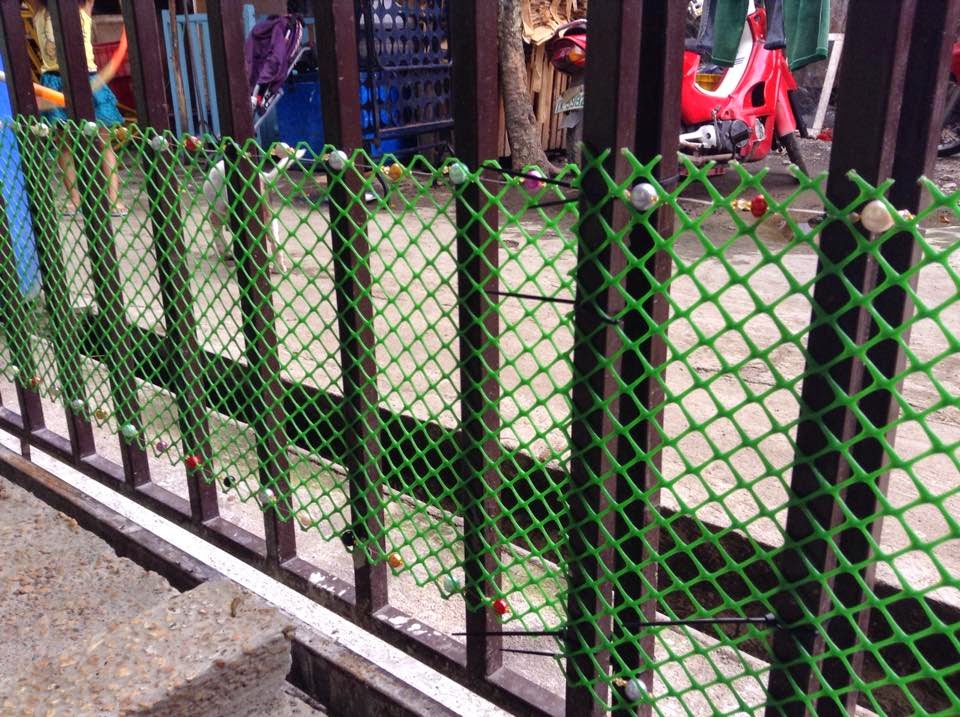
We just moved in this new apartelle. It's brand new, and we were the first occupants. However, stray cats and three newborn puppies have been roaming around our place, sometimes urinating and leaving poop on our doorstep. We have already notified the owner of the puppies but they are still roaming around, so we decided to act on our own and keep the peace in the neighborhood. Here are three easy steps that we did yesterday. Yes, we devoted one whole day for this project:

1. Buy chicken wire from the hardware and cut it into the desired size. (One foot in our case, just to cover the lowest part of our gate).

2. Embellish it beads or buttons, depending on what is available in the household. 


3. Install your personalized "Keep the Dogs Out" project. 


A little effort for a nicer look of the chicken wire. We were looking for a spray paint within the area but there was none If you're going to do this, we recommend that you paint it with your favorite color. You'll love the way you solved the problem. Try it!

Wednesday, August 14, 2013

BUENA MANO

Have you been to any market in the Philippines at a time when the store owners are just setting up their goods, or they probably just opened, early in the morning? If you have, then you must have heard the words..."Buena mano lang po." It is the statement often used to make the first sale, something that is believed to bring handsome profit for the rest of the day.

"Buena mano" literally means "good hand" from Spanish words buena (good) and mano (hand). According to historian Ambeth Ocampo, the use of this phrase started during the time when those calesa drivers or cocheros took good care of the horse by feeding them well and keeping the carriage clean. These men managed to teach horses to follow traffic rules and not do a counterflow. Hence, passengers were in good cochero hands. But just as calesas can now rarely be found except in Intramuros, Laoag, Vigan, and few other places, the meaning of "buena mano" has changed in time.

Consuelo J. Paz of the University of the Philippines on the other hand, had a paper "Compounding Old and New Words in Filipino" which stated that Spanish compound word like the colloquial term "buena mano" (after you) has undergone semantic change in the Philippines. It has been used to mean the first buyer or customer.

However, there is more to that phrase now than just Paz's meaning. "Buena mano" has become a good luck charm that is believed to bring good sale from the first transaction till the closing hour of the day. It is believed that if the first sale is good, the rest of the day will be. For good vibes, the first customer that comes upon the store's morning opening should make a good buy. In some communities where people know each other, there are instances when the seller would request somebody known to be a lucky "buena mano" to make the first purchase so that the goods will be sold out (buena mano, ubos!) The money from the first successful transaction is usually being patted on the items for sale in the belief that by doing so, good luck will come. Moreover, any negative happening within the day is usually blamed from a not-so-good first transaction during the opening of the store for that particular day.

There are times when a customer that bought something has to change an item, for whatever reason. From a seller's point of view, it is not a good practice to change that very early when a considerable amount of sale is not yet made. In times like this, the customer is asked to come back later in the day as the store has yet to have its "buena mano." Some other store owners do not buy anything in the morning unless they had made their first sale.

Buena mano is not at all bad nor one-sided. Consumers get to pick the best when buying vegetables that came from the farm in tyangge on market days. It is also a perfect time to do haggling. The seller usually gives the first buyer a good discount believing that the first sale has to be made so that more transactions will follow. In the process,  the customer gets a discount while the seller gets the first sale.

Now, are you thinking of making your next purchase early in the morning? Sure you are, but it has to be made in a public market--- not in the mall!


Friday, June 28, 2013

LOPEZ LINGO: intersection with, and peculiarities from TAYABAS TAGALOG

An excerpt from the paper presented to the 7th ATAGAN: "PANHIK" Tayabas Studies Conference  

 c. 2012 by Maria Gemma A. Suguitan-San Jose

Ay tano?” doesn’t seem Tagalog to many. But in fact, it is!

Tagalog became the basis for the Philippines’ national language called Filipino, understood by most Filipinos all over the world. However, not all Tagalog-speaking provinces have the same words, meaning and usage. Quezon Province for one, has its own uniqueness and twang that is not familiar in Metro Manila, Bulacan, and even in the Southern Tagalog Provinces namely Cavite, Batangas, Laguna, and Rizal. Even within Quezon, there are still differences in words in some towns and cities. This study on Lopez Lingo locally known as Salitang Lopez, discusses the similarities of words used within the province--- the so-called Tayabas Tagalog (Manuel 1971), and its pecularities that is only understood by the townspeople in Lopez, the Lopenzes.

Historically, Lopez (old name Talolong) was merely a sitio of Gumaca. Distance from the town and alarming presence of pirates urged the people to file a petition for it to become independent from its mother town. Several petitions were made by Lopenzes in the late 1700s before it became Visita Talolong. Hardwork of the natives in the field of agriculture and natural endowments to the bountiful land opened an avenue for migration of families from other towns in the province like Mauban, Lucban, Tayabas, etc. One of those who migrated was Don Mateo Lopez, said to be from whom its present name was derived. He had been considered the founder as he was cabeza when Talolong was declared a pueblo according to local history, on 30 April 1856--- until I found out that in 1856 it was Carlos Matriano and in 1857 it was Antonio Olivares, and the town’s foundation was actually 30 June 1857. (Errors in our local history is discussed in another book, though).

Being one of the oldest towns in Quezon is but one of the characteristics that probably contributed to the development of its language, or dialect, if we are to accept that some Tagalog words are considered standard and some are provincial. (But why make it appear lesser of a language just because it is not used in Metro Manila?)  There are other factors. Once called Tiangge Capital of Quezon, people from nearby places come to this town on market (tiangge) day to buy agricultural products that occupied six major streets in the poblacion. Moreover, it has the largest and most advanced hospital in the area, the Magsaysay Memorial District Hospital where patients from nearby towns are brought to be treated. The point is, people from other places often come to Lopez and it may have enriched rather than affected the language negatively. Being geographically far from Metro Manila may also be one of the main reasons why the language had remained untouched, and Lopenzes naturally love Salitang Lopez.

The people of Lopez have high regard for education. Once the students graduate from high school, most parents send them to universities in Manila. In case of these students and other Lopenzes working in Metro Manila or any other place outside Quezon Province, Salitang Lopez may have been set aside when talking with other people as they easily adapt to “eh” and “kasi” of the city but with townmates, native language is usually used wherever they meet.

Salitang Lopez is a variety of Tagalog that has evolved through time yet mostly preserved and enjoyed even by the youth of today. More than a thousand words circulate from still unknown origin even before Spanish occupation in the country. This is one of the reasons why it was declared winner in a 2010 national competition called “Doon Po Sa Amin.” Like Filipino Language though, it also has a mixture of words coming from the Chinese, Spanish, English, the Bicol Region, Marinduque, Laguna, Batangas, even from Ilocos and the Visayas; and of course, Quezon. There has not been any prior study to examine each of the words closely but in the hope of preservation so that the future generation will still be able to understand the language of their ancestors, Arella-Suguitan Museum with the help of Lopez Heritage Conservation and Historical Society (formerly Lopez Culture, Arts, and Tourism Council) have compiled the Lopez Words since 2004. I began in 2001, continuously doing it until the present time. We cannot wait for authorities to do it for us but we would be very glad to welcome linguistics experts and lexicographers to make us understand better what we need to know about our mother tongue. Most of Salitang Lopez are not found in the Filipino dictionary. Or if the words are included, they have different meanings. There was even a Fil-Am who asked, ‘How can I teach Lopez Lingo to my kids when they don’t find it in the dictionary?’ That is what we are working for right now. Just because it is not part of the standard Tagalog does not mean that it does not exist. I have come up with a local reference but in fear of being called a pseudo-linguist by those who have advanced study about languages, it is humbly entitled, “Katuturan.”      

Today, Lopez is a First Class Municipality that is home to five major learning institutions mostly state universities like Polytechnic University of the Philippines (PUP) Lopez, Philippine Normal University (PNU) Quezon Campus, Laguna State Polytechnic College (LSPU) Lopez, Technological University of the Philippines (TUP) Lopez, and Quezon Provincial Training Center of the TESDA. There is an influx of students from all over the neighboring towns, in the Bondoc Peninsula, and even from the nearby municipalities in the Bicol Region. Some graduates from these institutions have married and settled in Lopez. This has become one of the reasons for urgency in the documentation of Lopez Lingo. Deterioration of native language cannot be compromised to the development brought about by the growing population. We cannot be complacent that the language will be preserved without extra effort from its people. There is a need for new settlers to adapt to the local language.   

When internet was created, it seemed like the end for cultural awareness to proliferate. It seemed like everything will be global and diversity will totally be gone. But looking at the things happening right now, the social media undoubtedly encouraged love for country, citizens are picking up the pieces of what still remains of local culture, constantly searching for roots and history, reminiscing what the local places were like before they got busy with work either in the Philippines or overseas. Those who thought that internet would transform the diversity of cultures into one global thing were all wrong. The social media has become an important vehicle for connection and "re-connecting."

I opened a page on Facebook in 2008 where I put pictures and encouraged discussions about our town, including Lopez Lingo. In no time, it has reached the maximum number of friends that it can accommodate. Everybody was happily interacting, communicating, reminiscing the past, using Salitang Lopez which most of the Filipinos abroad have not used nor read for a long time. And it has become their routine to chat and once again, use the words that had been kept in their memories for quite sometime. The World Wide Web has become a friend to local language which used to circulate only within the community. It has become easier to introduce or re-introduce it to the most number of people just with one click of the mouse. The world has gone smaller but the colors have gone brighter! Preservation of the language is one good practice alright, but promotion is another. Through the use of the social media, the language has been promoted and the joys of those involved don’t seem to end.

The book of E. Arsenio Manuel published by Diliman Review “A Lexicographic Study of Tayabas Tagalog of Quezon Province” was the primary basis that I used for delineating which belong to Quezon and which belong to Lopez alone. Since it was published more than forty years ago, changes must have already transpired in time. Nonetheless, PANHIK Tayabas (Quezon) Studies Conference is one of the few instances where Salitang Lopez had taken center stage as we proved our uniqueness as a town and sharing Tayabas Tagalog with the rest of Quezon with which we also share one heritage. A few more words have already found their own space in the Filipino Dictionary. Hence, we have to settle to the research that is done this year, hoping that this initiates a longer and more detailed study on the “other” Tagalog referred to as Lopez Lingo, Lopezspeak, Lopez Words, or simply, Salitang Lopez!

And now, a few examples…Note that the words with asterisk are Tayabas (Quezon) Tagalog. Otherwise, it’s from Lopez:

1.    alab-alab/ bala-bala mean kunwari or to pretend:
Alab-alab ay tayo ay magkababag.
Let us pretend that we are enemies.

2.    alagiag* means di-mapakali or uncomfortable, anxious
Tano at ikaw ay alagiag?
Why are you anxious?

3.    alik-ik* means ipit na tawa or giggle
Nag-aalik-ik sa isang sulok ang kanilang angkin.
Their adopted child is giggling in the corner.

4.    asapmo’y/ isimo’y mean tila, parang, or looks like, acting like
Isimo’y mayaman yung ale.
The woman looks like she's wealthy.

5.    atas* means tanggal or detached, unbound
Hirap namang sulatan nung kuwaderno, atas-atas na.
It’s difficult to write on that notebook, the pages are detached.

6.    balho* means bago or before
Manabo ka muna balho magbaldeyo.
Fetch water first before washing the floor.

7.    bangkiya* means sumama or to tag along 
Huwag ka ng bumangkiya at ika’y may abyarin.
Don’t tag along anymore because you have tasks to attend to.

8.    bunghalit means tawang malakas or to suddenly laugh aloud
Napabunghalit ako nang nakita ko syang bitbit ang mga abubot.
I suddenly laughed aloud as I saw him/her carrying knickknacks.

9.    butbot* means kuwago or owl
Bait, takot ka nga ba tuo sa butbot?
Little child, are you really scared of the owl?

10. butwa* means angatin or lift
Butwain mo ng bahagya para malaman mo kung mabig-at.
Lift it slightly so you will know whether it is heavy.

The examples given here are but a few of the words that have been in use in Quezon and Lopez. Though they may still be known at this point in time, the possibility that it will vanish is always there--- just as the abuhan has been replaced by electic stove or microwave, abaniko has been replaced by electric fan or air conditioner, tambo has been replaced by the vacuum cleaner--- therefore, there is no time to waste now that there is still opportunity to preserve and document everything. The whole Tagalog speaking population has not even known these words yet. Should we lose it or use it? Ay tano’t babayaang mawala?  

Thursday, June 20, 2013

FBFs: How Well Do You Know Them?

Facebook Friend! That's what "FBF" means, (and I checked it out at InternetSlang.com). How many Facebook Friends or FBFs do you have in your friends list? Do you know all of them?

Fulfilling! I did have a very tiresome yet worthwhile afternoon today by checking who are in my list, more than 13 hundreds of them. Not too many, compared to those who have full account which means more than five thousand. I saw family members, relatives, namesakes, former classmates, block mates, schoolmates, town mates, office mates, board mates, dorm mates, friends, acquaintances, mentors, inspirations, and a handful of strangers that I have to check later on. The latter, I have accepted for reasons like too many mutual friends, same hometown, or mere trustworthiness. I wrote all names on a 17-page yellow paper because that would be the most convenient way for me to search them and visit respective pages. I'm not techie enough to have 'captured' the page or downloaded them, (if at all possible). 

Foolishness? Not really. Those I am most familiar with, I really want to get in touch. Those names which are strange, I would want to get to know well. And those which are fictitious, empty or dummy accounts, I wouldn't be guilty to delete on my list, in order to accommodate more interesting people who would want to be friends with me on Facebook. 

Friends are treasures, so goes the saying; and I want to keep them close to my heart. Now, how well do you know your FBFs?

PART 1: ANGELS in my LIST 

Today, I just had a chat with Rence. I met him at the 1st Laguna Blogging Summit (1LaBS), then I joined his Postal Heritage Tour last December. He asked me if I would want to promote my books at the Royal Postal Heritage Tour that we are going to have on the 21st of July 2013; to which I agreed. Just a few minutes after posting at the events page, I already got orders from people I met in the tour last year.

Also today, I invited some FBFs to like my new page Queen's Gems where samples of the bead jewelry I have been designing are posted... and I saw some angel friends who readily heeded to my call. Oh, I love friends who support my projects! Not just bead-making but even my events and advocacy.

I have this habit of searching my name through Google, another craziness that I share with those people who do it. And I found newspaper articles about some of my activities written by yet other angels on my friends list. 

Getting to know my FBFs better will continue as I document little details here. I am richer today than yesterday as I have found FBFs who are angels in disguise; not to mention the endless joy and excitement  brought to me by my word buddies in Words with Friends, mental challenge and entertainment right where I may be.

How about me, am I also an angel to them? I try my best to return the favors. Human relations are give and take. It's a two-way process.

COMMENTS that ENRICH, LIKES that INSPIRE  

I love reading comments from friends. I learn a lot from them. It doesn't matter whether they are highly academic or not. Every comment on each thread is meant to be read and even one-liners or just a word can make a difference.

I give comments and like pictures too. There had been a few times when I got bothered with posts which  signal suicidal tendencies that I did my best to let my friend see the better side of life. One friend, a municipal mayor, even joked that my comments are paragraphs--- to which I replied, "that's why I had my blog, my comments cannot be contained in a small box." I find it enriching to exchange ideas about everything under the sun. Some I know some I don't. It also gives me an opportunity to research or just Google once in a while.

Even "likes" inspire us most of the time, especially when the person who clicks the like button is special to us, or rarely does it. Have you had that awkward feeling that no one likes the post that you expected friends to like? Even Facebook usage is a learning experience!

READING POSTS, REVISING QUOTES

I read posts. Even long ones if I have time. These are opportunities to learn something out of it, and get to know your friend who posted it as well. Quotes that flood may sometimes reflect the person who posted it, though other times they just find it cute and may not have anything to do with them. I have this habit of revising quotes to fit me or my friends. We don't always have to agree on what we see. The keyword is learning and entertainment. Social networking must be fun, it must be light, and it must always revolve on the essence of keeping our FBFs and getting to know them better!

UPDATE with STATUS and ACHIEVEMENTS

Good news is all around, and so are the bad ones. By checking on the status of our FBFs, we become updated with the goings-on. We even have continuous news feed about them, all it takes is to go online.  

Sunday, June 16, 2013

Bodjie Pascua: Father of Storytelling in the Philippines

Who doesn't know Kuya Bodjie? Nobody, I guess.

Today is Father's Day. While scrolling down my news feed, I saw a post with his picture where I commented, "Father of Storytelling--- just one of the hats that he wears." Out of curiosity, I googgled if there had been somebody who held that title before. As I had not found any, at least for today, then my comment in that post is valid... until such time that I find out I was wrong.  

There's already a lot of publications about him. Who would read my work? I don't really care at all if this blog would be read by anyone. I just want to note today that it occurred to me that he should be given that honor, or maybe he has already received it. I am not abreast with every detail about his life, anyway. All I know is that he's been looked up by children especially during the time of Batibot, and even by the adults, for his creative way of telling stories. He's an actor both on stage and in film. I may not be an authority to write about him but I had admired Bodjie the moment I heard him lecture during the First National Conference on Children's Literature in 2003. It was one of the events that I cannot forget as the speakers were really authorities in their field. 

When social networking sites were created, it gave me a chance to see a little more about him. The more personal side, I guess, or his "facebook side," for that matter. So far, I have seen him as an extraordinary person who has known himself and the universe so well, who continuously inspires me with his posts, the style of writing that he shows, and the way of thinking that he possesses. I am not alone, I could see that he has thousands of fbfs (facebook friends) who subscribe and comment to his posts.  

If there had been an award accorded to him or had there been somebody who gave him the title "Father of Storytelling in the Philippines," my apologies. I had no idea about prior recognition. I do not claim to be the first, either, but I see this title as something that nobody fits but him. He may not be the first storyteller to have existed but the unique style that he has introduced is surely original. He made a difference to something that has existed long before he was born... storytelling. How I wish to be like him, somebody who has understood his art so well and converted complex theories into simpler ones better understood by all!

Happy Father's Day to one of the greatest Filipinos I have known, my fbf, Luisito Pascua!     


Thursday, June 13, 2013

Happy Father's Day to Grandfathers!

I would like to greet all grandfathers who had taken the role of father for their grandchildren... Happy Father's Day!

It's been thirteen years since I left our home. It was a decision that I had prayed for a year. Every time I was alone I would talk to God and pour out all the repressed emotions and say, "If this is not the life that's meant for me, please take me out of it." Then one day it happened. 

I did not go home to my parents' house right away. I had to stay with my sister until such time that I was ready to tell my parents about it. My father was in the US, he attended my Lola's funeral. When he came back, he learned about my decision. From that time on, my daughter stayed with my parents while I worked for three years in my husband's hometown which had also become my town for the past eleven years--- maybe hoping for a miracle to happen--- but it did not come. 

Instantly, my father became my daughter's Dad, my mother her Mom, and I was like a sister to her while nursing a broken heart. My daughter became my youngest sister. she was eight, and Papa looked after her like he did to the three of us, his children. She has been lucky enough to have him for a father, who had been and still is, perfect for us. He loves all of us unconditionally. Not to mention how much he loves our mother! 

Now that we are going to celebrate Father's Day this Sunday, I am writing this little tribute to all the grandfathers out there who have sacrificed for their grandchildren. I know my child's fate is not isolated. I know there are many of them, and there are grandfathers like Papa...

What makes it different though, must be the fact that he never spoke ill about my husband. And our family picture still occupies a space in our bedroom in my parents' house. I guess that's how much he loves his granddaughter!


Tuesday, June 4, 2013

HERITAGE VOLUNTEERS? Meron ba noon?

Our young historian and technical consultant, Qusaj. 
May is National Heritage Month! As this year also marks the 10th year of our organization since we had that Culture Orientation, Strategic Planning, and Festival Management Workshop that brought together all the culture advocates of our town, I would like to show you some of the activities  that we had, being volunteers and friends of the museum.

Of course, we conduct meetings. We used to have it outdoors like in Matinik Beach and in Pansol Floating Cottage, but in order to adjust to the availability of our members, our museum has become the official meeting place for all our recent get together and discussions. 

SCA Lopez Chapter has joined us since December 2012 when we had Huntahan at Historyan to discuss the errors in our existing local history. 

They were basically the reason why we proceeded with the project  Ani ng Sining 2013.


L-R: Mila Capanzana, Gemma Suguitan-San Jose, Elsa Basila-Paraiso, Adrien Argete-Merjudio, Milagros  Zamora-Loreto, Marietta Arella-Suguitan, Rose Requiron-Arella, and Raquel Olivo-Villanueva 

L-R: Perla Basanta, Gemma Suguitan-San  Jose, Belen  Lonisa, Ching  Flavier, Mila  Loreto, Margie Suguitan
Adrien Argete-Merjudio, Wilda Soliman-Bobier, and Marietta Arella-Suguitan,  are  but three of our  active members.
We don't miss important gatherings as much as we could. Friendship has grown among us. 
Here are but some of  the activities we have done for the past decade: 

Recognition of  international and local artists from Lopez (photo  courtesy  of  Armenta  Family)
I saw these chairs in one of the barangays. Was it an original design? Notice that  it's  personalized,  with the name of the child that owns it. It can still be improved, and we do support local talents. We also help them promote their work.

Publication of the books ABC Begins with H and  KATUTURAN  Dictionary  of  Lopez  Tagalog
We supported the research work of the students at LNCHS on their entry on Language by providing relevant information regarding Salitang Lopez.

We went to the booth that they prepared at the SM Mall of Asia to give last minute insights about our own unique language.


And they won in the Language Category, National Competition!


Promoting volunteerism, Qusaj interviews Col. Vener Rojas on her personal advocacy to help our veterans. 
Huntahan is one of the best ways to get to know the culture  of  our barangays.
Bead making workshop with indigenous kababayans in Villaespina

Cultural immersion with the "kulot" community in our town.


Gathering historical data about our town (photocopy of the Expediente  from  National  Archives courtesy of the Local Government of Lopez) 

Inventory of  local flora and fauna
Preservation of indigenous art

Continuous research on local foods, culture, arts

Promotion of local products. In this photo by JR Arella, Qusaj hands a  siete colores shell  fan  to  Miss Young International during the  1st World Art Experience held at the Art Capital of the Philippines, Angono, Rizal.
Product development... Small fans were made into leis for special guests.

Documentation of local products


Exploring Lopez and its natural resources 
Coordinating with the Department of Trade and Industry on their  assistance to  local  entrepreneurs

Conducting heritage education
Organizing seminars on culture, history, and the arts
To assist the Chief Girl Scout working on preservation of cultural  heritage, we  conducted a  "Seminar  sa Pamana ng Kultura sa Kasalukuyang Henerasyon" with the theme "Babaeng Iskawt at Kabarangay, Tagapagtaguyod ng Tradisyon at Kaunlaran."

In the same project, there was storytelling and even reenactment of  the legend of the barangay. To preserve the Dalit Kay San Roque, it was recorded and taught to the younger generation.   

Tisod, piko, balud, and siklot were some of the traditional games that  were  taught to the  younger  generation.


Supporting seminar workshops on culture and the arts

Coordinating cultural activities 
Heritage Education through Lakbay-Aral  is usually gained  by attending the  meetings and events  of the Southern Luzon Association of Museums (SLAM) 
During the Sesquicentennial of Jose Rizal, the National Historical Commission of the Philippines, together with other cooperating agencies encouraged everyone to be Rizal's kalakbay by visiting all the places that had significance in the life of Rizal. Rose Requiron-Arella, together with her daughter and son-in-law completed that tour. Queen Suguitan San Jose likewise visited those places, except for Cebu and Iloilo, but she went to as far as Dapitan. It was in Dipolog Airport that she met the team of her relatives.

Kalakbay ni Rizal: Rose Requiron-Arella and Queen Suguitan San Jose  in  Dapitan 
Both Rose R. Arella and Gemma Suguitan-San Jose were appointed to the Provincial Commission for Culture and the Arts (PCCA)


Constant coordination with the National Commission for Culture and the Arts (NCCA) for everything that concerns our local culture and arts
Learning to read and write the Baybayin, ancient script of the Filipinos.

ANI NG SINING 2008 By virtue of the project proposal that we submitted to the National Commission for  Culture and the Arts (NCCA) we became one of the few grantees all over the Philippines to celebrate Bountiful Harvest of the Arts in 2008. This was published in the NCCA's Magazine Agung: 

This was our logo for the first Ani ng Sining in 2008
Agung, a publication of the National Commission for Culture and the Arts  (NCCA)
Being one of the few grantees all over the country, our celebration was published   in Agung.


Project Chair Sarah Manza and husband Chris co-sponsored the event .
2013
Arella-Suguitan Museum Volunteers
Lopez Quezon International (LQI) (under the leadership of Emmanuel Yngente) was a major sponsor of this activity,  represented by Beth  Nethel and Rose Arella of LPHS Batch '68.
Balse de Anahaw by Prof. Gina D. Sarahan (music by Julius Dotado)  was launched  during the  2nd Harvest,  Ani ng  Sining 2013.
KATUTURAN Dictionary of  Lopez Tagalog was launched on this occasion.
We had symposium with the following speakers:
Prof. Gina Dotado Sarahan for dance
Writer Boy Villasanta on Pop Culture
Marivic Leopando Sante on Poetry and Dance in a Poem
Aside from the exhibits by artists JayR Arella, Tito Loreto and Macoy Almase,  student artists  rendered their own  interpretations of the theme "Celebrating Icons."
Representatives of Arella-Suguitan Museum with Project Chair  Sarah Manza  hold the artworks  done by the students.
Short Films Festival spearheaded by the SCA  
Mrs. Loreto, receiving the token for artist Tito Loreto her son, who exhibited some of his works during the Philippine Arts Festival.
Heritage advocates with artist Macoy Almase who served as judge and exhibited  some of his works  during the event.
Student Catholic Action  (SCA) Lopez Chapter had their visitors drop  by the  plaza  to witness our celebration.
the organizing committee with guests
Some members of Lopez Heritage Conservation and Historical Society
Adrien Argete-Merjudio and other donors shared in giving away these beads to those who attended the event at the Catholic Center. 
tokens from Queen's Gems 
Medals from Prof. Crispulo Alarde

Annual celebration of International Museum Day

We always attend the Feast of Ascension in Villa Escudero. It's a privilege that we have enjoyed through the years being an active member of the Southern Luzon Association of Museums (SLAM) where Conrado Escudero is President Emeritus. It's a Filipino Feast at its finest, where all the guests are dressed up in Filipiniana, even the diplomats from other countries. 
Jocelyn Olivarez and Qusaj at the Feast of Ascension

Friends of the Museum at the Feast of Ascension in Villa Escudero

We joined SM Hello, Quezon Campaign by bringing our Anahaw Festival   to Lucena.


We try to reach out to more people for cultural/ heritage  education
Continuous learning for better service
We joined the 1st World Art Experience on Nov. 22-28, 2006 where most of our delegates won awards, led by visual artist JR Arella who had a grand slam!

and receiving recognition for all the volunteer work and advocacy to inspire more kababayans to do the same!

There's still a lot of activities not included here but it's a bird's eye view of what we do. As we continue to live happily and do things together, we hope to attract more volunteers who will be with us on this journey and commitment.Now that it's out, you will no longer ask, Heritage Volunteers? Meron ba noon? Meron po!